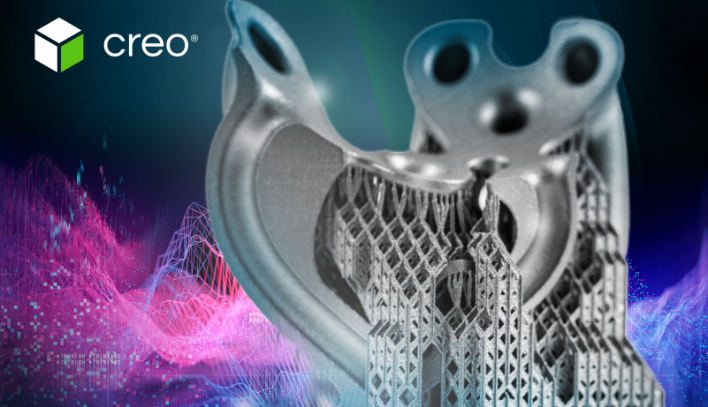
3D CAD solution designed to create better products faster
Creo is a 3D CAD solution designed to help you create better products faster; it accelerates product innovation and lets you recycle the best of your designs.
Creo supports you from the first phases of design through to the development of intelligent, connected products.
With Creo‘s powerful cloud-based augmented reality, you can collaborate with whoever you want, at any time, at any stage of the product development process.
With industrial CAD, think differently, be more productive and design smarter.
Optimizing time-to-market is a key element in standing out from the competition, and therefore in guaranteeing reliable and secure profits.
Demands are constantly increasing, and products are becoming ever more complex. Creo is the CAD system that takes all these demands into account, thanks to the continuous development of new features.
Creo 10
The next generation of 3D CAD for faster, smarter design
Creo 12, the new version of 3D CAD software developed by our partner PTC, is designed to transform your industrial design processes. With powerful new features and an optimised user interface, Creo 12 helps you design faster, more accurately and more efficiently.
Choosing Creo 12 means relying on:
1. Increased daily productivity Concrete improvements in ergonomics and workflows allow engineers to save valuable time at every stage of modelling.
2. High-precision composite material design Creo 12 offers unique power in composite modelling, essential for challenging industries like aerospace and automotive.
3. Model-based definition (MBD) Optimise your technical documentation with enhanced MBD tools for clearer and faster communication across teams.
4. Generative design and integrated advanced simulation Leverage the power of AI to automatically generate optimised designs based on your technical constraints.
5. Advanced additive and subtractive manufacturing Prepare your models for 3D printing or CNC machining with integrated, accurate and powerful manufacturing tools.
6. Electrical design improvements Improved tools for electrical harness modelling, essential in complex embedded systems.
A new generation of composite design
A data-centric modelling approach
An intelligent generative design model
An optimised additive & subtractive manufacturing
A new generation of composite design
A data-centric modelling approach
An intelligent generative design model
An optimised additive & subtractive manufacturing
An ergonomic interface for a user-friendly experience
Creo 12 is a 3D CAD solution designed for engineers:
• Creation of flat assemblies from multi-body parts
• Predefined functions to speed up modelling
• Enhanced integration with Windchill for smoother product data management (PLM)
• Intelligent contextual help: tooltips, what’s new topics, and more
Whether you operate in aerospace, defence, automotive, or advanced manufacturing, Creo 12 is the leading 3D CAD solution for faster and better innovation processes.
Creo +
Creo+ is the latest innovation in CAD solutions. It combines the power and trusted features of Creo with new cloud-based services to enhance team collaboration, improve user productivity and streamline license management and administration.
No data translation
Fully Creo compatible
Identical CAD features to Creo
Close integration with Windchill
Evolution of SaaS services in Atlas
No data translation
Fully Creo compatible
Identical CAD features to Creo
Close integration with Windchill
Evolution of SaaS services in Atlas
Creo+‘s main components are:
•Cloud-based licensing • Real-time synchronization and updates • Management of groups, users and collaboration sessions • Creo deployment automation • License usage telemetry
Creo+‘s main benefits are:
•Reduce the time, effort and overhead involved in managing Creo licenses and deploying them to users, departments and regions. • Real-time updates, automatically synchronized and accompanied by detailed feedback, so you always have the latest and best version of the design. • Better visibility of overall Creo usage across the organization, groups and users
Creo Simulate
Simulation & Analysis
With Creo Simulation Live powered by ANSYS, you can get real-time advice on design decisions as you make them.
Creo Simulation Live runs in the background, providing feedback as you modify your part and/or assembly design. Mechanical simulation with Creo Simulate offers you a host of features:
• Structural analysis • Linear steady-state thermal analysis • Material libraries • Meshing • Optimization • Post-processing
With the Creo Flow Analysisextension, every engineer can carry out a CFD analysis.
As products become ever more complex, and lead times ever shorter, a CFD solution becomes indispensable, enabling you to ensure the correct flow of liquids and gases right from the start of the design process, through analysis.
With Creo FAE, you can reduce costly prototype testing and gain vital information about your products.
Generative Design
The design of your products is accelerated by generative design since Creo 7.
In the Creo Simulate environment, the tool generates design scenarios based on the requirements and constraints you have defined.
A cloud extension will even let you generate multiple designs at the same time, with the best design options automatically highlighted to help you make the best choices.
Generative design will make real-time simulation much more flexible, as it means you don’t have to leave the CAD environment. Generative design is perfectly suited to additive manufacturing.
Additive manufacturing
With Creo Simulate, you can design, optimize, validate models and then verify printing from a single environment.
Processing time is reduced to eliminate time-consuming and mistake-making tasks.
In particular, you can design your parts for polymer and metal additive manufacturing by connecting directly to the printer you want.
The file will contain optimized support and printer profile structures. Currently, Creo Simulate enables you to cover 70% of the metal printers on the market.
Model-based definition
Creo 6 has set the standard for model-based definition.
In a model-based definition system, all product information resides in a fully detailed 3D model, accessible to everyone from engineers to package designers.
Improved processes make it easier than ever to create and publish the complete model-based definition.
Model-based definition systems offer many benefits:
• Increased productivity • Reduced costs • Consistency • Elimination of errors due to human intervention • Improved distribution of designs • Improved understanding of the GD&T process
Contact our experts
We use functional and analytical cookies. If you continue to use this site we will assume that you are happy with it. You can also use the "Revoke consent for cookies" button in the footer at any time Privacy Policy