

Scoping
Laying the Foundations for a Successful Digital Transformation
Before launching a PLM initiative or a broader Digital Transformation program, industrial companies need a clear understanding of where they want to go and how they will get there.
That is precisely the purpose of Scoping: helping organizations define a Vision, assess their Current Situation and build a realistic Transformation Roadmap.
To better understand its value, we spoke with Stéphane Moncoucut, Senior PLM Consultant at Percall Group.
What exactly is scoping?
Scoping is a strategic pre-project phase designed to help companies define their Digital Transformation objectives and the path to reach them.
Typically, we work with a three-year horizon. We help organizations answer fundamental questions:
- What are their business ambitions?
- What challenges are they facing?
- How should their processes and information systems evolve to support future growth?
The objective is to create a shared vision that aligns Business goals, Processes, Organization and Digital tools.
What are the main stages of the process?
A scoping engagement generally follows three key steps.
1.
We assess the Current State by reviewing existing Processes, Tools, organizational Structures and areas of Improvement.
2.
We define the Target State. This involves understanding where the business wants to be and why in the coming and identifying the capabilities needed
3.
We build a Transformation Roadmap, outlining the Phases, Priorities and Investments required to move from the current situation to the desired future state.
Why is the value proposition such an important part of scoping?
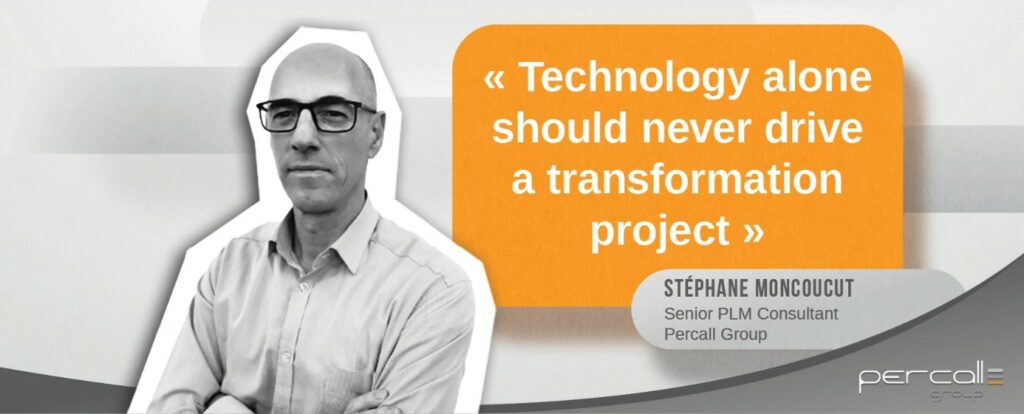
Because technology alone should never drive a transformation project.
The starting point is always the business challenge. Depending on the organization, priorities may include reducing development cycles, improving product quality, accelerating time-to-market, supporting international growth, or increasing operational efficiency.
But transformation is not only about doing things faster or more efficiently. It is also about enabling innovation, helping companies develop differentiated products that strengthen their market position and support long-term competitiveness.
Sustainability is becoming an equally important objective, with Manufacturers increasingly focused on creating products that are more environmentally responsible, easier to recycle, and designed to meet future regulatory and societal expectations.
From these objectives, we identify expected benefits and measurable outcomes.
Some gains are financial, while others involve improved Collaboration, stronger Governance or more efficient Processes.
This focus on Value ensures that the transformation remains aligned with business objectives rather than becoming a purely technological initiative.
How important is business & industry expertise?
It is essential. A consultant must understand not only the technology landscape but also the client’s industry, processes and stakeholder challenges.
During Scoping, we typically interact with Engineering teams, Project Managers, Quality departments, Manufacturing, Procurement, and Executive leadership.
Each stakeholder brings a different perspective. The challenge is to create a common understanding and translate those different needs into a coherent Transformation strategy.
How does a scoping project work in practice?
A Scoping engagement usually starts with workshops involving the key stakeholders across the organization.
These sessions help identify Challenges, gather Requirements and understand Strategic Objectives. The Consulting team then analyzes the findings, defines the target vision, evaluates transformation scenarios and develops recommendations.
The process ends with a formal restitution, providing management with a clear roadmap, budget estimates, and recommendations for the next steps.
Depending on the scope and complexity, the duration can range from a few weeks to several months.

What are the most common pitfalls?
One common mistake is trying to address too many topics at the same time. Successful Scoping requires a well-defined scope and a focus on the subjects that are mature enough to support decision-making. Expanding the perimeter unnecessarily often leads to complexity without creating additional value.
It is also important to ensure that the PLM Scoping exercise is aligned with the company’s global Information Systems roadmap. A PLM transformation cannot be considered in isolation, it must consider existing and future initiatives across the IT landscape to identify dependencies, priorities, and potential synergies with other programs.
Another key factor is stakeholder involvement. Digital transformation cannot be driven solely by operational teams, management and decision-makers must also be engaged throughout the process.
Finally, the conclusions must address the concerns of all participants. Every stakeholder should recognize their priorities and challenges in the final recommendations.
Final thoughts
Scoping is much more than a preliminary assessment. It is a strategic decision-making tool that helps organizations align Business objectives, Operational needs and Digital capabilities around a shared vision.
By defining the current state, the target state and the roadmap in between, companies can:
- Reduce risks
- Prioritize investments
- Maximize the value of their Digital Transformation initiatives