
Mastering quality
A key driver of performance
In high-demand sectors quality is far more than a goal, it is a fundamental condition for performance and sustainability.
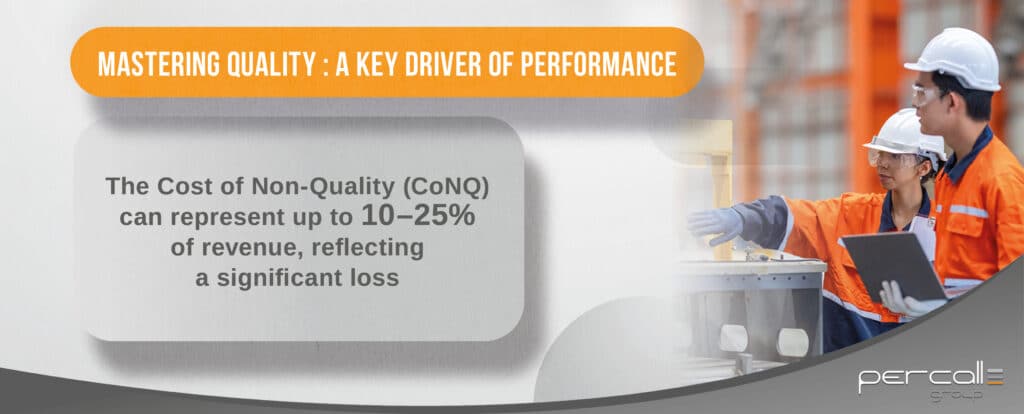
Quality issues can have severe consequences: high costs, extended lead times, disrupted flows, customer dissatisfaction, and damage to brand reputation. The Cost of Non-Quality (CoNQ) can represent up to 10–25% of revenue, reflecting a significant loss of margin and profitability.
This is why high-performing supply chains focus on prevention upstream rather than detecting defects at the end of the line. Quality is built from the very first step and managed continuously.
Quality Control and Quality Assurance: An Inseparable Duo
It is essential to prevent quality issues from creating bottlenecks, line stoppages, or cascading rework.
Anticipating quality problems whether related to raw materials, preventive maintenance, or production lines is critical. Implementing automated intermediate controls and connected sensors contributes to this optimization.
This real-time approach gives production teams immediate responsiveness.
At the same time, strengthening quality assurance at a global level is crucial. It defines methods, standards, and frameworks (ISO 9001, EN 9100, IATF 16949…) that structure traceability and compliance throughout the cycle.
It ensures consistency across all supply chain stakeholders: suppliers, production, logistics, and customers.
With quality control and quality assurance well integrated, the supply chain becomes more fluid, predictable, and resilient to disruptions.
End-to-End Quality Management
To secure overall performance, mastering quality at every stage from raw materials to final delivery is vital.
End-to-end quality management helps prevent deviations, safeguard flows, and optimize productivity while reducing the Cost of Non-Quality and strengthening competitiveness.
In practice:
- Upstream: raw material checks and supplier qualification.
- During production: inspections at each workstation and across production lines, process monitoring, and preventive maintenance to anticipate any drift.
- Downstream: final inspection, document validation, and feedback analysis to ensure compliance and foster continuous improvement.
The benefits are tangible: complete traceability, reduced hidden costs, on-time delivery, and stable flows.
End-to-end quality management is a strategic lever for competitiveness.

MOM and PLM: Allies for Connected and Responsive Quality
Digital tools such as MOM (Manufacturing Order Management) and PLM (Product Lifecycle Management) provide a global, real-time view of flows, machines, and performance. They enable centralized orchestration and control of operations for maximum responsiveness.
Key benefits:
- Real-time defect detection
- Reduced cycle times and scrap
- Flexibility and rapid process adaptation
- Predictive maintenance to optimize equipment availability
- Data compliance and simplified audit preparation
- Centralized control and full traceability
Integrating MOM and PLM transforms quality into a connected, measurable, and proactive process, offering a complete view of the product lifecycle and forming a solid foundation for continuous improvement and supply chain performance.
Quality management: Driving supply chain excellence
The integration of MOM and PLM solutions turns quality management into a performance driver. These tools provide real-time process visibility, enhance traceability, accelerate deviation detection, and strengthen control over lead times and costs.
They directly contribute to:
- Improving quality
- Increasing customer satisfaction
- Enhancing brand image
With our expertise and field experience, we support manufacturers in digitizing their supply chains, securing deployments, and adapting tools to operational needs.
Thus, quality becomes a sustainable engine of competitiveness and operational excellence.